
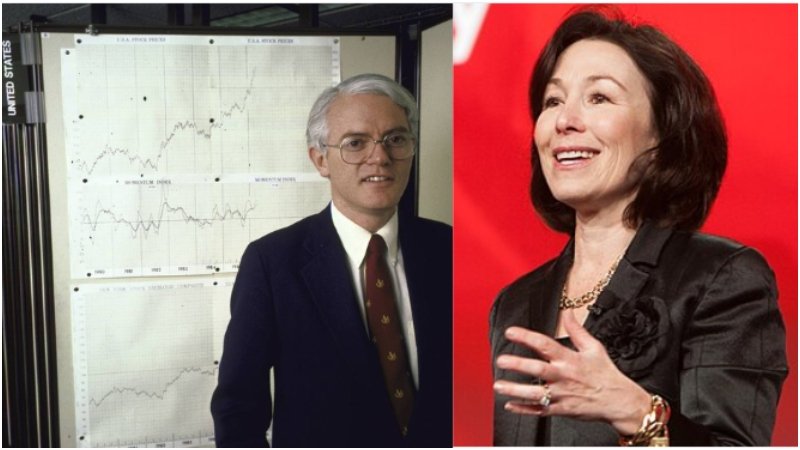
In the world of financial markets and corporate leadership, there are some names that have changed the way business is done forever. On one side, there is Peter Lynch, who introduced a new way of looking at stock market investing through the Fidelity Magellan Fund and became a Wall Street legend. On the other side, there is Safra Catz, who took the leadership of Oracle Corporation and set new standards through multi-billion-dollar mergers and expansion in the technology industry.
Although both of them belong to different fields, their strategic thinking and financial discipline have become an inspiration for investors, businesspeople, and entrepreneurs around the world.
In this topic, I will share detailed information about their lives, the key to their success, and the research-backed facts and achievements that made them successful in their respective fields.
The Inspiring Life Journey of Peter Lynch
Peter Lynch was not the son of a rich or famous businessman. He achieved his success through hard work and struggle. When he was only 10 years old, his father died of cancer. To help with household expenses and support his mother, Lynch started working as a caddy at Brae Burn Country Club at just 11 years old, where he carried golf equipment for players. This was where the journey toward his success began.
The golf club where Lynch worked was visited by many successful businessmen, stockbrokers, and corporate executives. While carrying their golf bags, Lynch would carefully listen to their conversations about the stock market and business. These conversations sparked his interest in investing.
His First Stock Investment: With the tips he earned as a caddy and some of his savings, Lynch invested in a cargo company called Flying Tiger Airlines at around $7 per share. Later, during the Vietnam War, the company’s stock rose to around $80. This early success increased his interest in investing and inspired him to build a career in the world of finance.
The Turning Point: Boston College to Wall Street Entry
While working at the golf club, Lynch met D. George Sullivan, who was a senior executive and later became President of Fidelity Investments. Following his advice, Lynch continued his higher education and completed his studies at Boston College with the help of a scholarship and the money he earned as a caddy. Later, he earned an MBA from the Wharton School at the University of Pennsylvania.
Fidelity Internship (1966): Because of his good relationship with George Sullivan, Lynch got a summer internship at Fidelity Investments in 1966. His first job was to research and analyze stocks in the paper, chemical, and publishing industries.
Military Service & Return: After his internship, Lynch served for two years in the U.S. Army, including service as a lieutenant near the Korean border. After returning from the Army, Fidelity hired him as a full-time research analyst in 1969.
The Peak of Success: Magellan Fund’s Record-Breaking Era
In 1977, Peter Lynch became the manager of the Fidelity Magellan Fund. At that time, it was a small and little-known fund, but over the next 13 years, Lynch turned it into one of the most successful mutual funds in history.
Asset Growth: When Lynch took charge in 1977, the fund had around $18 million in assets. By the time he left in 1990, the fund had grown to about $14 billion.
29.2% Annual Return: During his 13 years as manager, the Magellan Fund achieved an average annual return of about 29.2%. This was more than twice the return of the S&P 500 during the same period. If someone had invested $10,000 in 1977, it would have grown to more than $280,000 by 1990.
Why He Stepped Down
In 1990, when Peter Lynch had become one of the most successful and respected people on Wall Street, he surprised everyone by announcing his retirement at the age of 46.
Lynch said that he was working around 80 hours a week and meeting the CEOs of 40 to 50 companies every month. Because of his busy schedule, he had very little time for his family. He wanted to spend more quality time with his wife, Carolyn, and their three daughters.
After retirement, Lynch continued to make an impact through The Lynch Foundation, supporting causes related to education, healthcare, and helping people in need. He also wrote three well-known books: One Up On Wall Street, Beating the Street, and Learn to Earn. These books are still considered valuable guides for investors today.
From Israel to Ivy League: Safra Catz’s Educational Roots
Safra was a very intelligent girl. She graduated from Brookline High School and after that, she went to one of America’s top Ivy League universities, the University of Pennsylvania (Wharton School), where she got her Bachelor’s degree. Along with finance and business, she also studied at the University of Pennsylvania Law School and earned her Juris Doctor (J.D.) degree in 1986.
This unique combination of corporate law and finance helped her build strong skills and later become a master of the M&A (Mergers & Acquisitions) world.
Mastering M&A: The Wall Street Years
After completing her law degree, Safra Catz did not go directly into the tech industry. Instead, she first turned towards Wall Street.
She started her career at the famous investment bank Donaldson, Lufkin & Jenrette (DLJ).
Expertise in Mergers & Acquisitions (M&A): While working at DLJ, she spent around 14 years on Wall Street and eventually reached the positions of Senior Vice President and Managing Director.
Her real strength was working on major deals involving tech companies. She handled multi-million-dollar deals, acquisitions, and financial restructuring, which helped her gain valuable experience in the business world.
The Oracle Transformation: Partnering with Larry Ellison
In 1999, Oracle founder Larry Ellison was impressed by Safra Catz’s M&A and financial skills and invited her to join Oracle. Safra joined Oracle in 1999 as a Senior Vice President. Her job was to help manage Oracle’s aggressive expansion, company acquisitions, and financial discipline.
While Larry Ellison was known for his big vision and grand ideas, Safra Catz focused on backend operations, execution, and profitability and made sure everything was managed strictly.
From Co-CEO to Sole CEO: In 2001, she joined Oracle’s Board of Directors, and in 2004, she became President. Then, in 2014, when Larry Ellison stepped down as CEO, Safra Catz and Mark Hurd became co-CEOs of Oracle.
After Mark Hurd passed away in 2019, Safra Catz became Oracle’s sole CEO and has been leading the entire company ever since.
Quick Comparison: Peter Lynch vs Safra Catz
| Comparison Point | Peter Lynch | Safra Catz |
| Primary Role | Asset Manager & Legendary Investor | Tech Corporate CEO & Investment Banker |
| Key Company / Empire | Fidelity Investments (Magellan Fund) | Oracle Corporation |
| Famous For | 29.2% Average Annual Stock Returns | 85+ Multi-Billion Dollar Mergers & Acquisitions |
| Core Success Strategy | “Invest in what you know” & Deep Research | Strict Financial Discipline & Operational Scale |
| Starting Journey | Golf Caddy (Childhood struggle) | Immigrant from Israel to Wall Street Law |
| Key Legacy Concept | Tenbagger Stocks & PEG Ratio Usage | Behind-the-Scenes High-Value Deal Execution |
Key Takeaway
Peter Lynch’s life teaches us the importance of hard work, courage, and never giving up. Peter Lynch built his name on Wall Street by investing in great companies, while Safra Catz worked behind the scenes to make Oracle’s financial system stronger.
The biggest lesson from both of their lives is that proper research and a strong understanding of numbers can be the key to real success. No matter what field we work in, if we do proper research and follow the right approach, we can greatly increase our chances of success.

Mr. Laim is the founder of SwaggerBlogs.com a digital destination for detailed celebrity biographies, pop culture updates, and lifestyle trends. Leveraging 4+ years of entertainment research, he curates clear, fact-checked, and reader focused bios of inspiring public figures and public personalities.
- Brianna Lyman Wikipedia, Bio ,Career, Age & Professional Life - October 16, 2026
- Is Mychael Schnell Married? Career, Personal Life, and Relationship Facts - October 12, 2026
- Clothing Style LWSpeakStyle: A Complete Guide to Modern Fashion and Personal Style - October 10, 2026